The Lapwing Collar represents a distinctive approach to knitted collar construction, employing individual leaf-shaped elements arranged in overlapping layers to create a dramatic shoulder piece. Designed by Alice Starmore, this pattern demonstrates advanced shaping techniques combined with thoughtful color placement.
Construction Method
The collar consists of individual leaf or petal-shaped pieces, each knit separately and arranged in concentric circles around a structured yoke. This modular construction allows for precise color control and creates the characteristic dimensional effect. The leaves overlap in a manner reminiscent of feathers or scales, with each successive layer building upon the previous to achieve full coverage and visual depth.
The technique differs from traditional collar construction in its use of discrete elements rather than integrated shaping. Each leaf requires individual attention to increases and decreases, typically worked with short rows to achieve the characteristic pointed oval shape. The pieces are then sewn or picked up onto a ribbed yoke base that provides structure and ensures proper fit around the neckline.
Design Elements
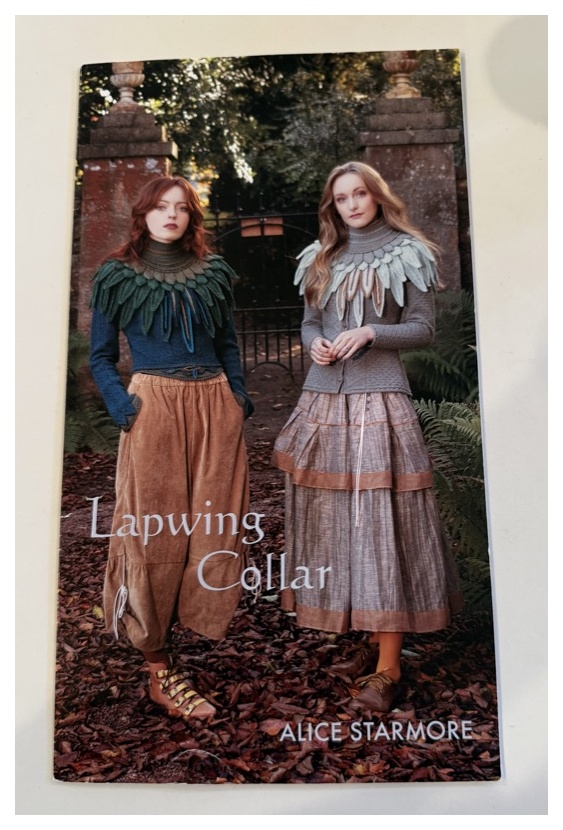
Two colorways are shown in the pattern photograph: a deep teal-green combination and a neutral gray-cream palette. The strategic placement of color values—darker shades at the bottom transitioning to lighter tones at the tips—creates visual movement and enhances the dimensional quality of the finished piece. This gradation is not merely decorative but serves to emphasize the overlapping structure of the leaves.
The yoke portion typically employs ribbing in a coordinating color, providing both structural support and a finished edge at the neckline. This element grounds the more elaborate leaf construction and ensures the collar sits properly on the shoulders.
Technical Considerations
Gauge becomes particularly important in this type of modular construction. Each leaf must be worked to consistent dimensions to ensure even coverage when assembled. The pattern likely specifies a fingering or sport weight yarn to achieve the delicate appearance visible in the finished pieces, though the exact specifications would be found in the published pattern.
The joining method—whether sewn onto a pre-knit yoke or picked up and knit—affects both the construction sequence and the final drape of the collar. Sewn construction offers more control over placement but requires careful attention to achieve even spacing. Alternatively, picked-up construction integrates the leaves more seamlessly but demands precision in the initial yoke preparation.
Wearing and Styling
The Lapwing Collar functions as a substantial accessory piece, intended to be worn over simple garments where it can serve as the focal point. The coverage extends across the shoulders and upper chest, providing both warmth and visual interest. The structured nature of the piece means it maintains its shape well, draping consistently across the shoulder line rather than collapsing or bunching.
This type of collar works particularly well with solid-colored base garments—turtlenecks, simple pullovers, or fitted long-sleeve tops—that allow the intricate leaf construction to remain the primary visual element. The dimensional quality of the overlapping leaves creates texture and movement without requiring complex stitch patterns within each individual leaf.
Joan’s Interpretation
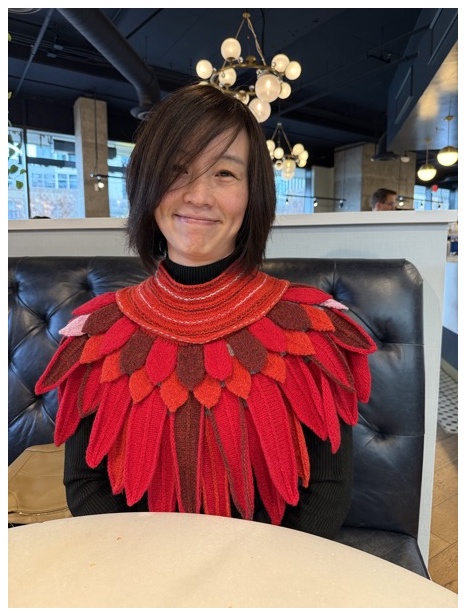
Joan’s approach to the leaf collar demonstrates an extended interpretation of the technique, creating a fuller capelet that provides more substantial coverage than the traditional collar length. Her piece features a rich color palette spanning multiple shades of red, from bright scarlet through burnt orange to deep burgundy and chocolate brown. This expanded color range creates greater visual depth and emphasizes the layered structure of the leaves.
The construction appears to utilize more layers than the standard collar design, extending the coverage further down the chest and back. This modification transforms the piece from a collar accent into a more substantial garment that functions as both a shoulder warmer and a statement piece. The increased leaf count requires careful planning to maintain even distribution and balanced drape across the extended area.
Joan’s color placement strategy employs a gradual transition rather than stark contrasts, with adjacent leaves in closely related hues. This approach creates a subtle ombré effect that maintains cohesion across the larger surface area while still providing the dimensional quality inherent to the overlapping leaf construction. The darker tones concentrated at the outer edges and tips add weight visually, grounding the piece and creating clear definition between layers.
The yoke construction in Joan’s piece features a ribbed collar in coordinating red-orange tones, maintaining the warm color palette throughout. The extended length of the piece requires particular attention to the yoke’s structural integrity, as it must support more weight and maintain shape across a larger perimeter. The ribbing provides the necessary stretch and recovery to ensure proper fit while accommodating the bulk of the attached leaves.
This interpretation demonstrates how the fundamental leaf collar technique can scale to create different garment types. By increasing the number of concentric circles and extending the overall radius, the collar transitions into a capelet, offering versatility in both function and visual impact. The approach requires more yarn and time investment but results in a more substantial finished piece suitable for cooler weather and formal occasions.
Pattern Availability
The Lapwing Collar is a published pattern by Alice Starmore, known for her expertise in colorwork and Celtic-inspired knitwear design. Starmore’s patterns typically include detailed instructions, charts where applicable, and thorough guidance on construction techniques. The pattern would specify exact yarn requirements, gauge, leaf count, and assembly instructions.
For knitters interested in this style of construction, the Lapwing Collar offers an opportunity to explore modular techniques while creating a distinctive wearable piece. The repetitive nature of the leaf construction allows for rhythm in the knitting process, while the assembly phase provides creative control over color placement and final arrangement.